
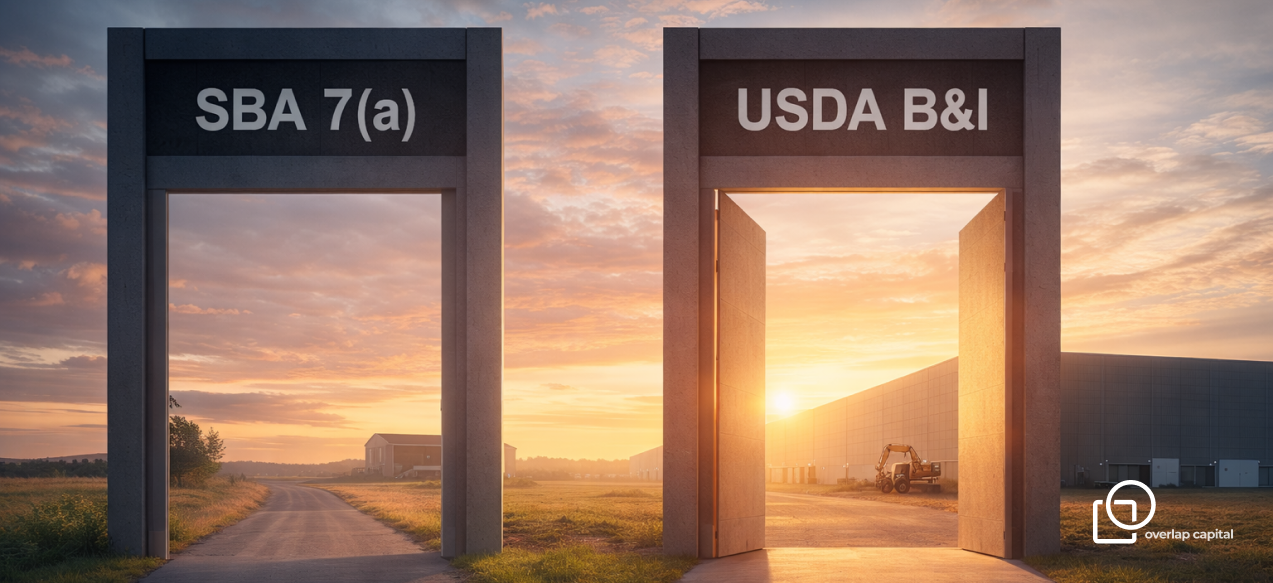
Did you know one of the most overlooked ways to fund a rural expansion, acquisition, refinance, or owner-occupied facility may not be SBA at all? USDA B&I is built for larger, harder-working projects hiding in plain sight.
For years, the SBA 7(a) loan has been the default answer in small business finance. Need working capital? SBA. Buying a business? SBA. Acquiring real estate? SBA. It became the loan product people named first, sometimes before they even understood the project. That default made sense for a long time. SBA 7(a) is widely distributed, broadly understood by lenders, and flexible enough to cover real estate, working capital, debt refinance, machinery, and even changes of ownership. It also has a maximum loan amount of $5 million, which is plenty for a lot of deals.
But “widely known” and “best fit” are not the same thing. That is where the USDA Business & Industry Guaranteed Loan Program starts to matter more than many borrowers, brokers, and acquisition specialists realize. USDA B&I is not a niche oddball for farm towns with a tractor fetish. It is a federal loan guarantee program for eligible rural business projects, and USDA says eligible uses include the purchase and development of land and buildings, machinery and equipment, supplies and inventory, debt refinancing that improves cash flow and creates jobs, and business and industrial acquisitions that maintain operations and create or save jobs.
That list should make capital strategists sit up a little straighter. Real estate. Equipment. Permanent working capital. Refinance. Acquisitions. Those are not fringe needs. Those are the exact categories driving many larger lower-middle-market projects right now. And unlike SBA 7(a), USDA B&I can support materially larger financings. USDA’s own overview says B&I loan terms can extend up to 40 years, while SBA states that most 7(a) loans max out at $5 million and generally top out at 25 years for real estate-heavy loans.
That difference is not cosmetic. It can reshape the monthly payment, the debt service coverage story, the sponsor’s equity posture, and whether a deal breathes or dies.
There is also a strategic shift happening in plain sight. A growing share of serious borrowers are not just looking for “a loan.” They are trying to finance a transition. They are buying an operating company from a retiring owner. They are refinancing expensive debt that made sense two years ago and looks stupid now. They are retooling equipment, modernizing facilities, or acquiring industrial real estate in places outside major urban cores. For projects like that, USDA B&I deserves more than a cameo appearance. It deserves underwriting attention. USDA itself has framed access to capital in rural America as central to its mission, and in announcing expanded B&I-related lending support, then-Secretary of Agriculture Sonny Perdue said, “Ensuring more rural agricultural producers are able to gain access to much-needed capital… is a cornerstone of that commitment.”
Why entrepreneurs keep defaulting to SBA
The SBA 7(a) program is popular for good reasons. It is available through a large lender ecosystem, it can fund multiple business purposes, and it is familiar to referral partners, accountants, attorneys, and borrowers. SBA says 7(a) proceeds can be used for acquiring, refinancing, or improving real estate, short- and long-term working capital, refinancing current business debt, purchasing machinery and equipment, buying furniture, fixtures, and supplies, and even complete or partial changes of ownership. That is broad utility in one box.
But popularity can create laziness. Once an industry gets comfortable with a product, it starts forcing unrelated projects into that product’s shape. That is how borrowers wind up trying to squeeze a larger rural acquisition, a significant facility buildout, or a chunky refinance into a program capped at $5 million. The result is often one of three bad outcomes: the project gets downsized, the capital stack gets awkward, or the deal dies of complexity and delay. None of those outcomes are especially inspirational.
USDA B&I changes the conversation because it lets bigger rural projects enter the room without apologizing for their size.
What USDA B&I actually covers
USDA’s own program page is refreshingly direct. Eligible B&I uses include business conversion, enlargement, repair, modernization, or development; land, buildings, and associated infrastructure for commercial or industrial properties; machinery and equipment, supplies, or inventory; debt refinancing that improves cash flow and creates jobs; and business and industrial acquisitions that maintain operations and create or save jobs. Funds may not be used for lines of credit, owner-occupied or rental housing, gambling facilities, lending businesses, and certain other prohibited uses.
That eligible-use list lines up almost perfectly with several of today’s most common larger-capital scenarios.
1. Buying or building business real estate
This is one of the clearest B&I use cases. USDA expressly allows the purchase and development of land, buildings, and related infrastructure for commercial or industrial properties. That matters for owner-occupied facilities, industrial conversions, manufacturing sites, warehouses, processing plants, logistics nodes, and other project-based real estate in eligible rural areas.
And yes, that can include projects the market now treats as mission-critical infrastructure. If a borrower is buying or building owner-occupied commercial real estate for a legitimate operating business in an eligible rural area, B&I belongs in the conversation. The point is not that USDA is now “the data center loan.” The point is that large commercial or industrial real estate projects in rural geographies should not automatically be shoved toward SBA simply because SBA has stronger brand recognition.
2. Machinery and equipment
Equipment finance is where B&I starts looking especially practical. USDA specifically permits the purchase and installation of machinery and equipment, along with supplies and inventory. That is highly relevant for manufacturers, processors, operators modernizing legacy plants, and businesses replacing outdated systems with newer technology.
One caveat matters here: cleaner-tech upgrades do not automatically mean B&I will finance the whole dream board. As of August 2025, USDA announced that wind and solar projects are not eligible under the Rural Development B&I Guaranteed Loan Program. So if someone says, “Great, we’ll use B&I for the solar field too,” the answer is: not so fast. Equipment modernization may still fit, but standalone wind and solar project eligibility under B&I is not there under current USDA policy.
That is exactly why capital strategy needs less vibe and more reading.
3. Permanent working capital for industry pivots
SBA is often thought of first for working capital because it explicitly allows both short- and long-term working capital. USDA B&I is more limited here, because the program does not allow lines of credit, but it does allow working capital, inventory, and supplies in the form of a term structure rather than a revolving facility. USDA’s official materials and overview both support that distinction.
That makes USDA B&I useful when a borrower is not asking for open-ended revolving flexibility, but for a permanent working-capital injection tied to a broader business plan: a pivot, a scale-up, a stabilization period after an acquisition, or a restructuring of operations. It is not the same animal as a revolver. If your borrower needs a line, USDA already told you no. If your borrower needs term-supported working capital inside a bigger rural project, now you are talking.
4. Refinancing debt
Debt refinance is not exciting on social media, but it is one of the most valuable uses in the real world. USDA says debt refinancing is eligible when it improves cash flow and creates jobs, and program materials spell out that the debt being refinanced must be tied to an eligible purpose and support a viable project.
That is a very real lane in today’s market. Companies that borrowed at the wrong time, borrowed too expensively, or stacked the wrong products are looking for cleaner structures. A refinance that lowers pressure on monthly cash flow while preserving or creating jobs fits the spirit of the program and, in the right case, can be a far better answer than pretending the original debt structure was “close enough.”
5. Business acquisitions
This is where the old mental model needs to be retired. SBA is not the only federal-guaranteed game in town for acquisitions. USDA expressly allows business and industrial acquisitions when the loan will maintain operations and create or save jobs.
That is a serious tool for succession deals, sponsor-backed purchases of rural operating companies, strategic tuck-ins, or acquisitions where the target is important to a local economy. When acquisitions are on the rise, B&I should rise with them. Not because it is trendy, but because the rulebook says it belongs there.
SBA 7(a) vs. USDA B&I: side by side
| SBA 7(a) | USDA B&I |
|---|---|
| Maximum loan amount is generally $5 million. | Supports eligible rural business projects rather than just SBA-sized borrowers. USDA’s borrower categories include for-profit and nonprofit businesses, cooperatives, Tribes, public bodies, and certain individuals engaged in eligible rural businesses. |
| Available only to businesses that are small under SBA size standards. | Eligible uses include land and buildings, infrastructure, machinery and equipment, inventory and supplies, qualifying refinance, and qualifying acquisitions. |
| Can fund real estate, working capital, refinance, machinery and equipment, supplies, and ownership changes. | Lines of credit are not eligible. |
| Maturities generally run up to 25 years for real estate-heavy loans. | Loan terms can be as long as 40 years under USDA’s program overview. |
| Guarantees are generally up to 85% for loans of $150,000 or less and up to 75% above that, with some exceptions for export-related products. | USDA regulations provide for guarantee percentages that can vary by program, with a maximum guarantee of 90% of eligible guaranteed loan loss. |
| The project must be in an eligible rural area, though a borrower’s headquarters can be in a larger city if the financed project itself is rural. |
In other words, SBA 7(a) is often the more familiar Swiss Army knife. USDA B&I is often the more interesting answer when the project is larger, rural, job-connected, and not well served by a $5 million ceiling.
Who should pay closer attention to USDA B&I now
Entrepreneurs seeking larger amounts of capital should care because program structure matters more as projects grow. A $1.2 million general-purpose loan can survive some product mismatch. A larger acquisition-plus-real-estate-plus-equipment project usually cannot. At size, the wrong loan product becomes expensive, restrictive, or simply unavailable.
Business acquisition specialists should care because B&I directly recognizes acquisitions as an eligible use when operations and jobs are preserved or created. That means rural acquisitions do not have to be treated as “SBA first, everything else later.” In some cases, USDA B&I may be the more natural lead product and SBA the backup plan, not the other way around.
Lenders and advisors should care because rural America is not just farms, diners, and folklore. USDA itself describes rural prosperity in terms of business growth, infrastructure, and community essentials, and the department’s mission language consistently ties capital deployment to economic security and opportunity in rural areas.
The smartest way to think about it
The question is not, “Is USDA B&I better than SBA?” That is a toddler question wearing a suit.
The adult question is, “Which guarantee program best matches this borrower, this project, this geography, and this capital need?”
If the project is broadly eligible, below $5 million, and needs flexible use-of-proceeds inside SBA’s size framework, SBA 7(a) still has every reason to stay busy.
If the project is rural, larger, asset-heavy, acquisition-driven, refinance-sensitive, or tied to a long-lived commercial or industrial facility, USDA B&I may be the sharper tool. It is not a secret weapon. It is just underused by people who stop researching the second they hear “SBA.”
That mistake gets expensive.
Need help sizing an SBA 7(a) against a USDA B&I strategy for a real estate deal, acquisition, refinance, or equipment-heavy expansion? Overlap Capital helps borrowers structure the story, test the fit, and pursue capital with fewer blind spots today.