
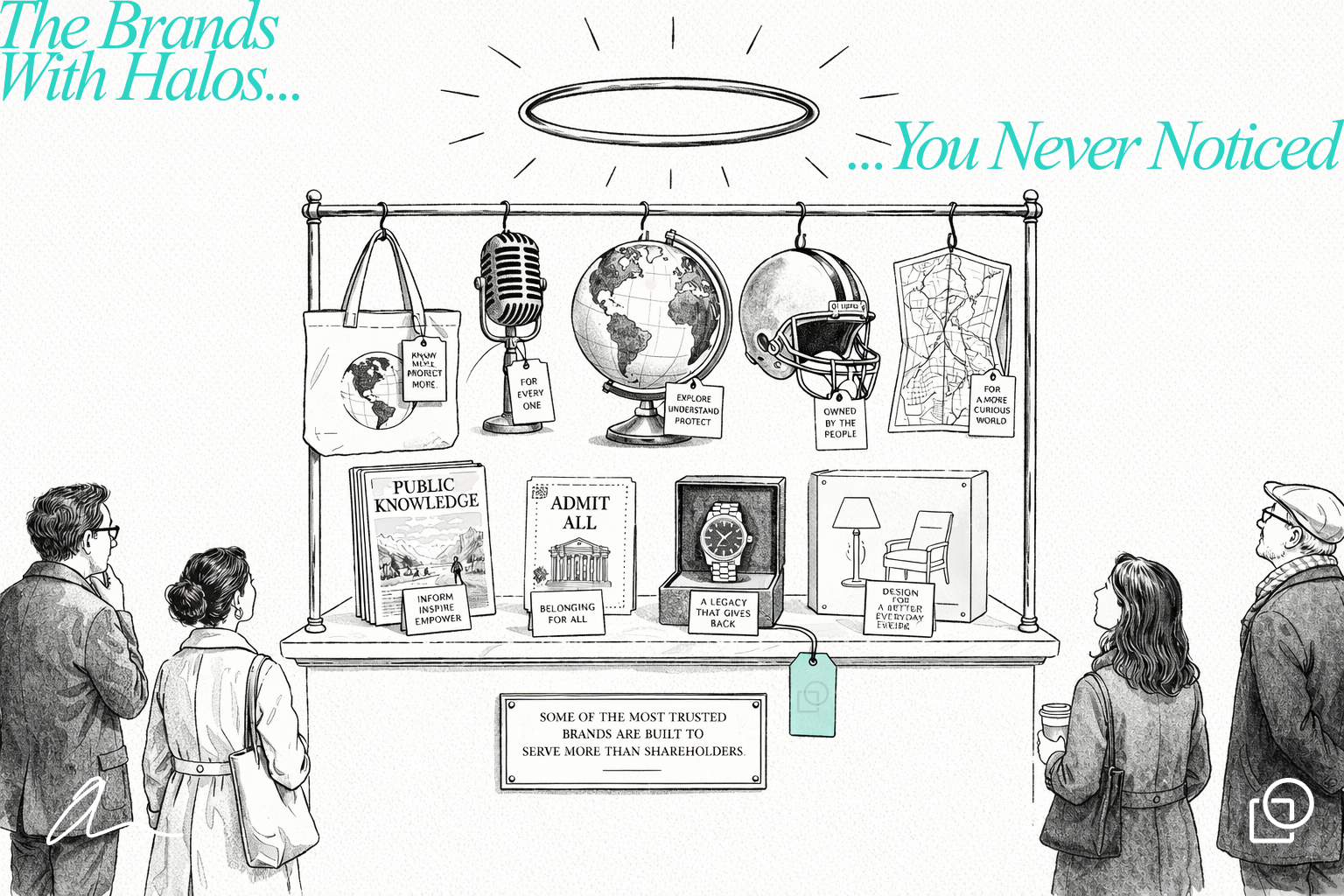
A funny thing happened on the way to American capitalism: some of the brands people trust, watch, quote, and tailgate around are nonprofit, quasi-nonprofit, or foundation-controlled. Charity is not hiding in the shadows. It is hiding in the logos, right under our noses in public.
The first surprise is that your original list is not wrong so much as crowded with different species of truth. National Geographic Society is a 501(c)(3). The Wikimedia Foundation behind Wikipedia is a 501(c)(3). PBS is a nonprofit public broadcaster. The State Fair of Texas is a 501(c)(3). Mozilla is the legal mullet of the bunch: nonprofit foundation up front, taxable corporate subsidiary in the back. Green Bay Packers, Inc. is a publicly held nonprofit corporation, which means one of the most beloved franchises in sports is not owned by a billionaire treating Sunday like a private mood board. Then come the nonprofit-adjacent creatures. Rolex is owned by a Swiss foundation. IKEA’s retail empire sits inside a foundation-linked control structure. These are not all the same thing, and lazy writing usually flattens them into one tidy myth. But the deeper point survives the cleanup: some of the world’s most trusted brands are built, governed, or protected by structures that put mission, stewardship, or benefit somewhere near the center of the machine.
That matters because business owners still talk about charitable giving as if it were a garnish. Nice, optional, and mostly there to impress somebody’s aunt at a luncheon. The tax code, irritatingly more practical than our clichés, has long treated giving as something more serious. For years, many owners and advisors repeated the 10 percent corporate limit on charitable deductions as the rule to remember. That older benchmark appears in IRS materials and rulings. Current IRS guidance now says a corporation may deduct qualified charitable contributions up to 25 percent of taxable income. So the clean version of the “did you know” is this: yes, giving can reduce a corporation’s taxable income, but the number many people still quote from memory is not the whole current story. The smarter takeaway is not “give wildly and let accounting sort it out.” The smarter takeaway is that philanthropy, when structured properly, belongs in the same strategic conversation as entity choice, brand design, capital planning, and customer trust. If that sounds unromantic, good. Romance is expensive. Proper planning is cheaper. The deduction is not the mission, and anyone who treats a charitable gift like a laundromat for conscience is missing both the legal point and the human one. But taxes shape behavior because incentives shape calendars, board agendas, and signatures. A company that plans its giving with intention can support real work, document the deduction correctly, and avoid the goofy pattern of making December generosity feel like a panicked coupon code for virtue.
The seldom-used angle is not that nonprofit status is noble. Every intern with a tote bag already knows that line. The more interesting angle is that nonprofit status, cause marketing, and commercial credibility often feed the same public-trust engine. When the National Council of Nonprofits says, “Communities thrive when nonprofits succeed,” it is giving away the whole plot in six words and a verb. People do not merely applaud institutions that create visible benefit; they lean toward them, work for them, partner with them, and buy from the for-profit cousins that stand near them without smelling fake.
Al Nolan put it more bluntly: “I care about clients spending a little less on taxes and making a little more impact because smart structure should reward usefulness, not just accumulation.”
That is not a sentimental statement. It is a market statement. Useful organizations attract goodwill that no media budget can fully manufacture. In an era when the public can smell costume jewelry through a phone screen, usefulness travels farther than polish.
Mr. Nolan has another view shaped by his years in corporate America, where the ritual of sponsorship was often treated like a decorative line item until everyone noticed it kept working.
“I saw a lot of value in cause marketing while working in corporate America,” he told me. “They’re not doing it for no reason.”
Exactly. They are doing it because values can organize demand. They are doing it because talent recruitment changes when younger workers believe the company means something. They are doing it because customers remember shared purpose long after they forget the third discount code in a week. They are doing it because community partnerships create distribution, trust, and staying power that conventional advertising often rents but never owns. None of this means every bakery, software firm, or holding company should sprint toward nonprofit conversion like it just heard free money falling from a helicopter. Some businesses should stay gloriously taxable. Some missions do not qualify. Some founders want equity upside, looser governance, and fewer restrictions on purpose. But for the right organization, nonprofit formation can unlock donations, grant eligibility, tax-exempt treatment, and a stronger public claim on why the enterprise deserves to exist. That is why the structure deserves more respect than it usually gets from business media, which too often writes as though the only mature motive is profit and every other motive is a hobby with stationery. There is also a governance lesson here that rarely gets said out loud in small-business circles: a mission with legal architecture tends to outlive a mission that lives only in the founder’s chest. Boards can be annoying. Reporting can be tedious. Restrictions can feel like a seat belt in a parked car. And yet those very frictions are often what turn a good intention into an institution rather than a charismatic season.
The comedy in all this is that America is endlessly moved by impact and endlessly suspicious of the paperwork that makes impact durable. We adore the hospital, the museum, the public media station, the scholarship fund, the youth league, the research society, and the local institution with your grandmother’s name on a brass plate. Then we act stunned when someone points out that law, governance, and tax treatment had to be arranged with unusual care to keep those missions alive. In other words, the halo did not descend from heaven fully stapled. Somebody had to file things, board things, govern things, and explain things to the IRS. The romance came later, after the bylaws. Consider the practical theater of it. A nonprofit is one of the few places in American life where the audience still expects the script to contain words like stewardship, service, and duty, and where those words, if matched by conduct, can still raise money instead of laughter. That does not excuse sloppy management. If anything, it demands the opposite. Mission-driven entities are trusted precisely because the public expects less extraction and more accountability. The reward for meeting that expectation is not merely applause. It is endurance. Donations recur. Volunteers appear. Partnerships compound. Credibility sticks. The institution becomes legible to strangers who were never in the room when the idea was born. For founders used to thinking only in campaigns, quarters, and customer acquisition costs, that is a different kind of asset: not just revenue, but civic memory. Quietly.
Overlap Capital helps founders decide whether nonprofit status truly fits, then shape the entity, story, and strategy around it. Becoming a nonprofit should be more than filing forms; it should be a disciplined move toward impact, credibility, and smarter tax planning that lasts.
For the factual backbone behind the piece: National Geographic Society, Wikimedia Foundation, PBS, State Fair of Texas, Mozilla’s nonprofit-plus-subsidiary structure, Green Bay Packers’ nonprofit status, and the IKEA/Rolex foundation-adjacent references are supported here.
For the tax point: older IRS materials reflect the 10% corporate limit, while current IRS guidance says a corporation may deduct qualified charitable contributions up to 25% of taxable income.
For the nonprofit-sector quote, “Communities thrive when nonprofits succeed,” I relied on the National Council of Nonprofits.
Overlap Capital can help you assess whether nonprofit status, a charitable affiliate, or a mission-first holding structure actually fits your goals, then map the formation, governance, capital, and compliance steps to get there without confusing tax folklore for strategy wisely.