
The layoffs are real, but so is the opportunity: the next wave of value will be built by professionals who stop waiting to be rehired and start rebuilding around what they know.
Layoffs are no longer a warning flare. They are the market speaking plainly: large institutions are protecting margins, buying Ai, and shedding people. The job may be gone, but the value in your head is not.
There is a particular cruelty to being laid off during a season of record profits, polished earnings calls, and executive language about transformation. What stings is not just the loss of income. It is the collapse of a story many professionals were handed early in their careers: study hard, join a respected company, build deep expertise, stay useful, and the institution will return that usefulness in the form of security, status, and a stable life.
That story is fraying in public.
In late March, Reuters reported that Oracle had begun layoffs affecting thousands of employees while increasing spending on artificial intelligence infrastructure. The company described the cuts as part of a “reduction in force and other terminations.” Clinical language, clear message. The modern corporation does not exist to preserve your continuity. It exists to allocate capital, defend margin, pursue strategy, and improve shareholder outcomes.
This is the new labor market in one frame: capital expansion on one side, labor contraction on the other.
That does not make every corporation evil. It does make dependency more dangerous than many workers were taught to believe. Prestige was never the same thing as permanence.
The worst cliché of the Ai era has been the smug line that Ai will not take your job, but someone who knows Ai will. It was always too neat. In many cases, workers are not being replaced by better workers. They are being displaced by financial decisions, workflow redesign, smaller teams, automated layers, or companies choosing not to refill the seat at all. Sometimes the function is compressed. Sometimes the role disappears.
But the work itself does not vanish as neatly as the org chart. Problems do not disappear because a budget line was cut. They simply lose their old container.
That distinction matters.
Many newly displaced workers are making a category error. They think they lost their value because they lost the institution that packaged and sold it. They are grieving a title and mistaking that grief for the death of their usefulness. But the value they created inside the company never belonged to the badge on the laptop. It lived in pattern recognition, judgment, domain expertise, delivery experience, customer empathy, process knowledge, technical fluency, and hard-won intuition.
A company may stop paying for that package in one format. The market may still need it in ten others.
You may not control whether a large company keeps your seat, but you can control whether your expertise remains trapped inside a résumé or gets turned into economic leverage.
This is where most layoff commentary collapses into sentiment. It tells people to network, update LinkedIn, take a breath, and stay positive, as if a cleaner headshot were a strategy. People do need to grieve. They also need a framework.
The real question after a layoff is not only how quickly you can get hired again. It is whether you can identify the exact value you created, strip it away from the brand that employed you, and relaunch it into the market under new working norms.
For years, many professionals have been trained to think in terms of employers, departments, and ladders. They know where they sat, who they reported to, and which systems they touched. But ask what problem they actually solved, and too many answers still sound like corporate geography. They describe internal nouns, not market value.
That is no longer sufficient.
When Big Companies Stop Hiring, Small Markets Start Paying
Not all at once. Not automatically. But increasingly, they do.
Large enterprises concentrate resources, but they do not own the world’s problems. Once they stop funding certain layers of thinking or execution, the need does not evaporate. Smaller businesses still need implementation help. Agencies still need technical operators. Founders still need financial modeling. Local governments still need procurement-literate consultants. Healthcare groups still need workflow modernization. Manufacturers still need data cleanup. Professional services firms still need Ai policy, automation design, and systems integration.
Dislocated work is opportunity, provided someone has the discipline to reorganize around it.
The emerging advantage belongs to people who can do four things at once: understand a real business problem, use modern tools to accelerate output, package their work into a credible offer, and create enough structure around that offer that banks, clients, and partners can transact with them as a business.
That is not motivational fluff. That is capital readiness.
Overlap Capital’s mission has never been to talk about money as abstraction. It is to help people and businesses become structurally prepared for capital, opportunity, and forward motion. In a layoff cycle, that mission becomes more relevant. Newly displaced talent does not just need optimism. It needs formation. It needs packaging. It needs a pathway from individual skill to institutional credibility.
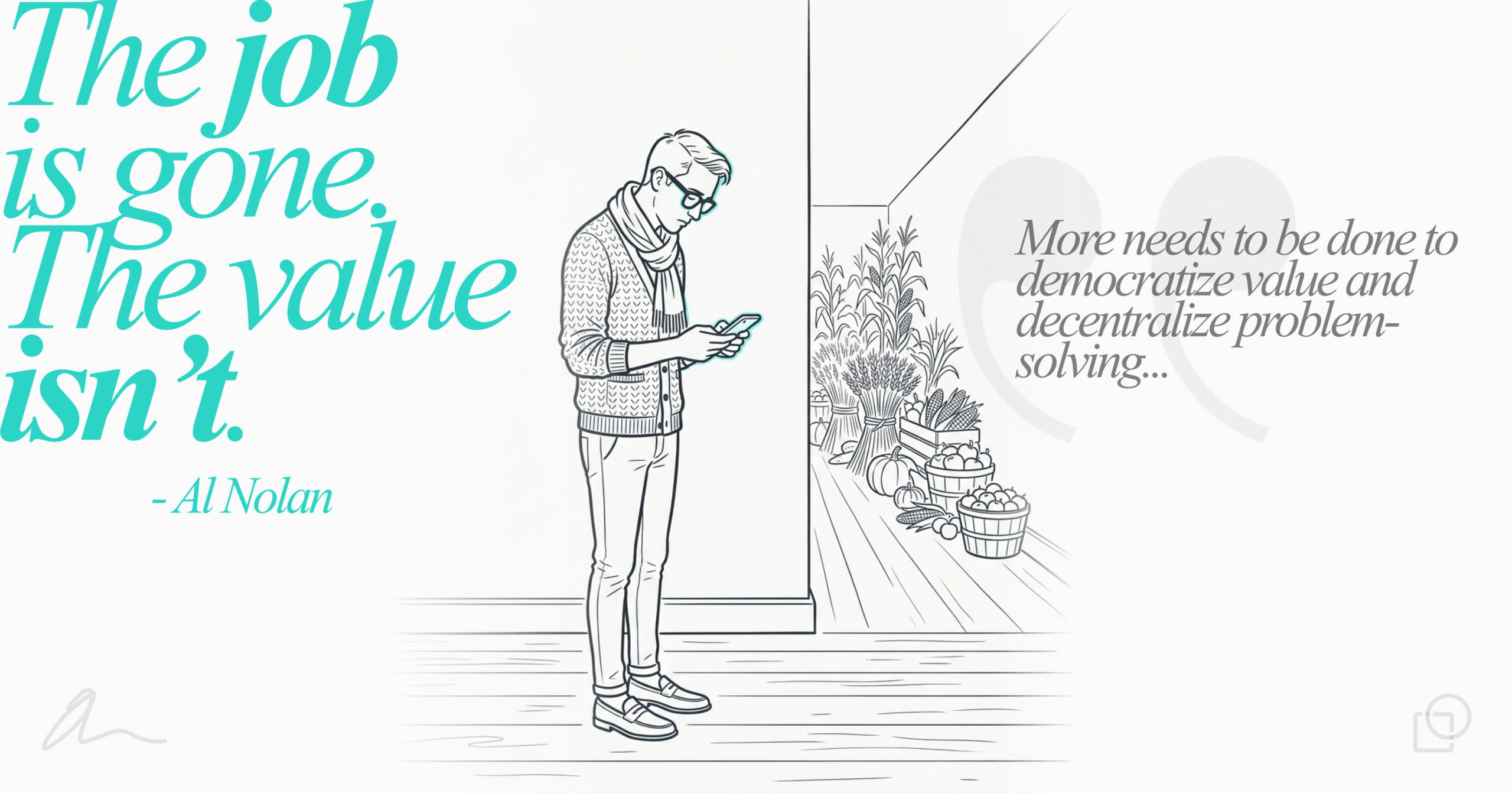
Al Nolan puts it plainly: “More needs to be done to democratize value and decentralize problem-solving, because large institutions are no longer reliable distributors of either.”
That line is bigger than layoffs. It is a thesis about the next decade of work.
The old model concentrated problem-solving inside giant firms and distributed compensation through employment. The newer model is distributing tools, access, and execution capacity more widely. Ai accelerates that shift by lowering the cost of production, research, drafting, coding, analysis, synthesis, and iteration. Tools that once required a team and a corporate sponsor now often require an operator with a laptop, a point of view, and discipline.
But the tools are not the full story. The working norms are.
If you were laid off from a large organization, your first instinct may be to recreate the exact conditions you just left: same title, same size company, same salary band, same bureaucratic grammar. That instinct is understandable. It can also become a trap. In a market where many companies are quietly redesigning teams around automation and tighter budgets, chasing the same old seat can become a months-long ritual of self-erasure.
There is another path.
Find your old teams, but not your old hierarchy. Find the people you trusted. The operators who delivered. The designers who understood constraints. The engineers who could translate ambiguity into execution. The finance people who could find the signal. The project managers who could shepherd work through chaos. Rally around talent, not to recreate a dead org chart, but to build new working norms.
The post-layoff economy may reward trusted constellations more than lone heroes.
In practical terms, the newly laid off should start asking different questions. Not who is hiring someone like me, but who still has the problem I know how to solve. Not which title fits my background, but which outcomes can I produce repeatedly. Not how do I get back into a company, but how do I turn my expertise into something the market can buy, finance, and refer.
Those questions lead to different behavior.
The first move is documentation. Record what you actually did before memory gets polished into corporate nonsense. Capture the systems, outcomes, constraints, failures, recoveries, tools, collaborators, and business consequences while they are still fresh. Most professionals underestimate how much strategic intelligence they carry because repetition made it feel ordinary.
The second move is translation. Turn internal work into external language. Most people do not buy “Senior Manager, Transformation Enablement.” They buy cleaner reporting, faster onboarding, fewer errors, better close rates, stronger bids, cleaner integrations, and more usable systems. The market pays for solved pain, not organizational poetry.
The third move is structure. If the value is real, it needs a container. Form the entity. Open the account. Build the basic credibility that lets a client hire you, a bank understand you, and a partner refer you without embarrassment.
The fourth move is capital discipline. If you still have verifiable income, documentation, and recent employment strength, understand the window you are in. Do not use it recklessly. But do recognize that timing matters in lending, in banking relationships, and in how financial institutions assess risk.
The fifth move is market focus. Do not think only about corporations. Think about founder-led firms, municipalities, healthcare groups, professional services practices, real estate operators, and regional institutions. Many still need the same caliber of thinking large companies just discarded. They simply need it in a different format and at a different scale.
That is where democratizing value becomes concrete.
For decades, a huge share of the economy’s most sophisticated problem-solving lived inside large employers. That assumption is becoming less stable. The expertise is still real. It is simply leaking into the open market, often involuntarily, through layoffs and restructurings.
That creates pain. It also creates redistribution.

Not general hustle. Specific usefulness.
Ai can make those networks more effective. It can help a two-person shop move faster, operate with less overhead, and behave like a larger unit in some domains. But tools alone do not create judgment, trust, or commercial empathy. Ai is leverage. It is not character. It is not strategy. It is not trust.
That is why the future will not simply reward people who “know Ai.” It will reward people who know a domain deeply enough to apply Ai responsibly, package outcomes credibly, and stay close to the lived reality of the client.
The newly laid off are not simply job seekers now. Many of them are understructured operators carrying years of institutional pattern recognition that smaller markets still need.
The question is whether they will do the work of repackaging it.
There is also a moral dimension to all of this. Work is not only income. It is identity, rhythm, affiliation, and proof of standing. A layoff disrupts all of that at once. That is why pride becomes dangerous in this period. Pride tells people that consulting is beneath them, that small clients are a step down, that temporary contract work looks like failure, and that their old title was the source of their worth.
Pride is expensive.
The more useful posture is sober ambition. Grieve, yes. Rest, yes. But then get honest about what the market still needs and whether you are willing to meet it in a form that does not flatter the old version of your career.
This is where Overlap Capital can help. Not by promising fantasy, and not by pretending every layoff is a hidden blessing. The help is practical. Overlap Capital can help newly displaced professionals think like entities instead of only applicants. It can help them translate knowledge into viable offerings, form credible structures, and become capital ready in the lived, transactional sense of being prepared to open accounts, pursue contracts, establish banking relationships, seek appropriate funding, and build something that can survive beyond a single invoice.
That matters because the future is not arriving evenly. Some people will get rehired quickly. Some will not. Some will move into smaller companies. Some will build firms. Some will combine consulting income with contract work, teaching, investing, or acquisition. The smart move is not to predict one universal path. The smart move is to stop leaving value unstructured.
The job is gone. The value is not.
Read that slowly if you are sitting in the haze after a separation call, a morning email, a revoked badge, or a vague reorganization notice. Your payroll relationship may have ended. Your utility did not. Your experience did not. Your insight did not. Your network did not. Your memory of what works, what fails, what costs too much, what takes too long, what breaks trust, and what clients actually care about did not vanish.
The next labor era will not be gentler. It may, however, be more open.
Large institutions will keep consolidating where it serves them. They will keep investing in infrastructure, automation, and defensible margins. But alongside that consolidation, there is an opening. More expertise is escaping the walls. More tools are available to smaller operators. More clients can buy sophisticated help without hiring a giant firm. More value can be captured by people who learn how to structure, finance, and market their usefulness.
That is the opportunity hidden inside the wreckage.
Not everyone will take it. Some people will keep waiting for the old promise to return. Some will spend too long chasing a title that was never a durable strategy. Some will use Ai badly, market themselves vaguely, borrow foolishly, or launch services no one actually needs.
The market is unsentimental in that direction too.
But for the worker willing to think clearly, act quickly, and build with discipline, this moment can become more than a story about loss. It can become the beginning of a different relationship to work itself, one less dependent on the moods of giant institutions and more anchored in portable value, structured capability, and direct problem-solving.
The economy is changing its shape. The people who survive it best may be the ones who stop asking where the next seat is and start asking what the market will pay for if they package what they already know.
That is not retreat. That is evolution.